


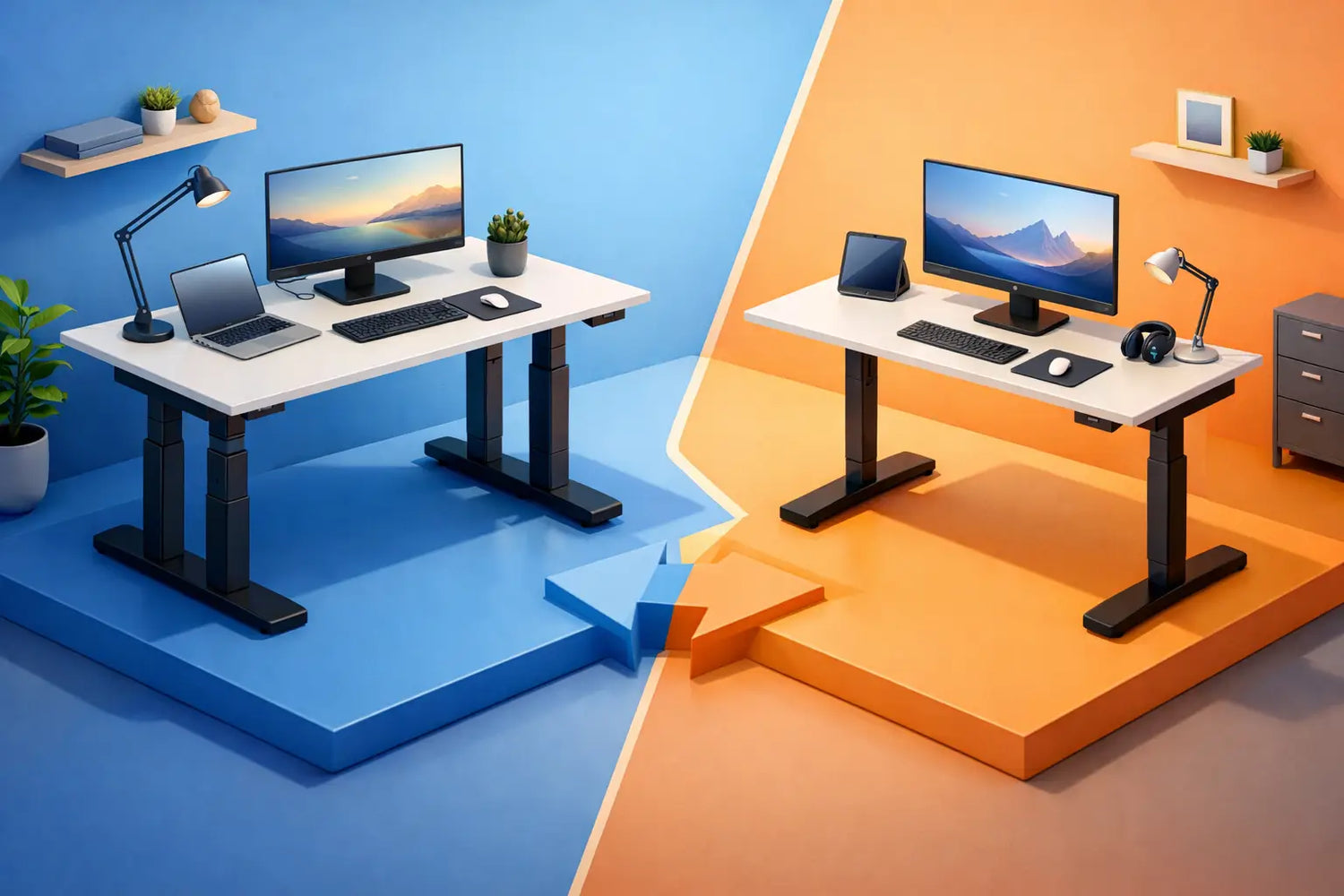
A standing desk should disappear into your working day. You press a button, it moves with quiet confidence, and your screen, laptop, oak surface and carefully arranged tools stay exactly where they belong. That is why the dual motor vs single motor desk question matters more than it first appears. The motor setup affects how a desk feels in daily use, how it handles weight, and how well it may serve your workspace over many years.
For a light, occasional workstation, a single-motor frame can be a sensible choice. For a substantial home office built around a solid oak top, multiple screens and equipment that stays on the desk, a dual-motor frame is usually the more considered investment. The right answer is not about buying the most complicated mechanism. It is about matching the frame to the desk you genuinely intend to live and work with.
Dual motor vs single motor desk: the real difference
A single-motor desk uses one electric motor to raise and lower both desk legs. Depending on the frame design, that motor transfers power through a driveshaft or gearbox to keep the legs moving together. It is a proven system, particularly on compact desks with modest loads.
A dual-motor desk places a motor in each lifting column. Each leg has its own direct source of power, while the control system coordinates their movement. This removes much of the mechanical transmission found in a single-motor design and gives the frame more lifting capability to work with.
The difference is not simply one motor versus two. It is about how force is distributed across the desk. A broad solid oak tabletop has real weight and presence, and it often carries a monitor arm, displays, a desktop computer, speakers, a lamp and the small objects that make a workspace personal. Two motors share that work more naturally.
Lifting capacity is only useful when it is honest
A dual-motor frame will typically have a higher stated lifting capacity than a comparable single-motor frame. That extra headroom is valuable, but it should not be treated as permission to overload a desk. The quoted figure may include the tabletop, or it may refer to the load placed on top of the frame. Always check what the manufacturer means.
More useful than chasing the highest number is allowing a healthy margin. If your setup weighs 70 kg, choosing a frame rated only just above that figure leaves little room for future changes or the natural demands of daily movement. A desk that is comfortably within its capacity tends to lift more consistently and puts less strain on its components.
For a laptop and one small screen, a single motor may be entirely adequate. For a wide desktop with dual monitors, an articulated monitor arm, heavier equipment or a thick timber top, dual motors offer the reassurance of reserve power.
Stability at standing height depends on more than motors
Motors lift the desk. They do not, on their own, make it stable. A frame's steel gauge, leg geometry, foot length, crossbar design, tolerances and overall construction have a major effect on side-to-side movement, especially when the desk is raised.
That said, a well-engineered dual-motor frame is often specified for more demanding desks and can be paired with a stronger structure. It is a good match for people who type intensively, draw, edit video, use a large monitor setup or simply dislike a desk that feels unsettled at standing height.
Do not assume that every dual-motor desk is better than every single-motor desk. A poorly made two-motor frame can still feel less composed than a well-built single-motor option. Look at the whole construction: the quality of the columns, the width of the feet, the tabletop support and the stated warranty all tell part of the story.
When a single-motor desk makes sense
Single-motor standing desks have a place. They are often less expensive, can suit smaller rooms, and are a practical solution for a simple workstation with a lighter top. If you alternate between sitting and standing a few times a day and keep only a laptop, keyboard and modest monitor on the surface, the reduced capacity may never become a limitation.
They can also be a thoughtful choice for a secondary desk. A compact study corner, a guest room workspace or a child’s future desk may not require the same mechanical specification as the primary place where you spend eight focused hours each day.
The trade-off is that the single motor is doing all the lifting. As the desk load rises, movement can become slower, and the transmission system has more work to do. This does not make a single-motor frame unreliable by definition. It simply makes correct use and realistic expectations more important.
Why solid oak changes the calculation
Material should influence your choice of frame. A thin laminate top is light and easy for almost any lifting mechanism to manage. Solid oak is different. It brings depth, natural grain, repairability and a weight that speaks to its substance.
That weight is part of the appeal. A proper oak desk feels grounded rather than temporary, and its surface develops character through years of work. Yet it means the frame should be selected as an equal partner, not an afterthought. A dual-motor steel frame provides the support and lifting confidence that a premium timber top deserves.
This is particularly relevant for larger formats. A 160 cm or wider desk offers room to think, spread out and create, but it also presents more tabletop weight and more opportunity for uneven loading. A computer tower at one end and a monitor arm at the other can place different demands on each side. Two lifting columns with their own motors are better placed to handle that real-world setup.
OAKO pairs solid European oak with steel dual-motor frames for this reason: where oak meets technology, both parts should be built for the long term.
Noise, speed and daily feel
Neither motor type should be loud enough to disrupt a calm home office when the frame is made well. Still, dual-motor frames often deliver a more assured lift under load because each leg is powered directly. The movement may feel more balanced when a desk carries substantial equipment.
Speed is a secondary consideration. A few seconds saved when changing height rarely matters as much as a controlled, even motion. What does matter is whether you feel comfortable raising the desk with your usual equipment in place. If you find yourself removing items before switching position, the desk is not supporting the way you work.
A good controller also improves the experience. Memory presets make it easier to use the desk as intended. Set one height for seated concentration and one for standing calls or lighter tasks. The more effortless the transition, the more likely you are to vary your posture through the day.
Choose for your next setup, not only your current one
Standing desks are long-term furniture. Before choosing between a single- and dual-motor model, picture the desk two or three years from now. You may add a second display, change careers, bring more equipment home or move to a larger room. You may also discover that your best working position needs a monitor arm, footrest or carefully managed cables.
A dual-motor desk makes particular sense if you work at the desk every day, prefer a larger solid-wood surface, use more than one monitor, or want a frame with capacity to grow. It is also the natural choice when the desk is the centrepiece of a considered workspace rather than a temporary solution.
A single-motor desk remains a fair option for lighter, simpler needs and a tighter budget. The key is to avoid paying for a beautiful tabletop while compromising on the mechanism that must carry it thousands of times. The desk should feel as dependable in year five as it does on the first morning.
A better question to ask before buying
Rather than asking which motor count is universally best, ask what your desk must support. Measure your intended equipment, account for the tabletop itself, consider the desk width, and think about how often you will change position. Then assess the frame as carefully as you would assess the oak grain or finish.
A well-made height-adjustable desk is not a gadget. It is a daily piece of working infrastructure, with the quiet task of supporting better posture, clearer focus and work that has room to unfold. Choose the motor system that gives your workspace the strength to stay useful, steady and beautiful for the years ahead.

Leave a comment
This site is protected by hCaptcha and the hCaptcha Privacy Policy and Terms of Service apply.