

A standing desk can look exceptional in a product image and still feel unsettled once it carries a solid oak top, two screens, a monitor arm and the rhythm of a full working day. Knowing how to choose a desk frame is therefore less about finding the lowest price and more about choosing the structure that will quietly support your work for years.
The frame is the working mechanism beneath the surface. It determines how smoothly your desk moves, how steady it feels at standing height, how much weight it can carry and whether its proportions suit the tabletop you have chosen. For a desk made from real oak, that foundation deserves the same consideration as the timber itself.
Start with the tabletop, not the frame
A desk frame should be selected around the top it needs to carry. This matters especially with solid wood. Oak has a reassuring weight and presence that laminate alternatives cannot replicate, but it also asks more of the base beneath it.
Measure the length, depth and thickness of your tabletop before comparing frames. A compact 120 cm top and a generous 200 cm work surface do not place the same demands on a frame. The wider the top, the more important it becomes to have a frame with an appropriate width adjustment range and a stable stance.
Also consider how you use the surface. A laptop and notebook create a light load. Dual monitors, a desktop computer, monitor arms, speakers and a desk shelf create a very different one. Choose for your complete setup, including the accessories you expect to add later, rather than the bare desk you own today.
Choose a desk frame with real stability
Stability is the quality you notice without thinking about it. When you type at standing height, adjust a monitor or rest your forearms on the desk, the surface should feel composed. A small amount of movement is normal in any height-adjustable desk, particularly at its tallest setting. Excessive sway is not.
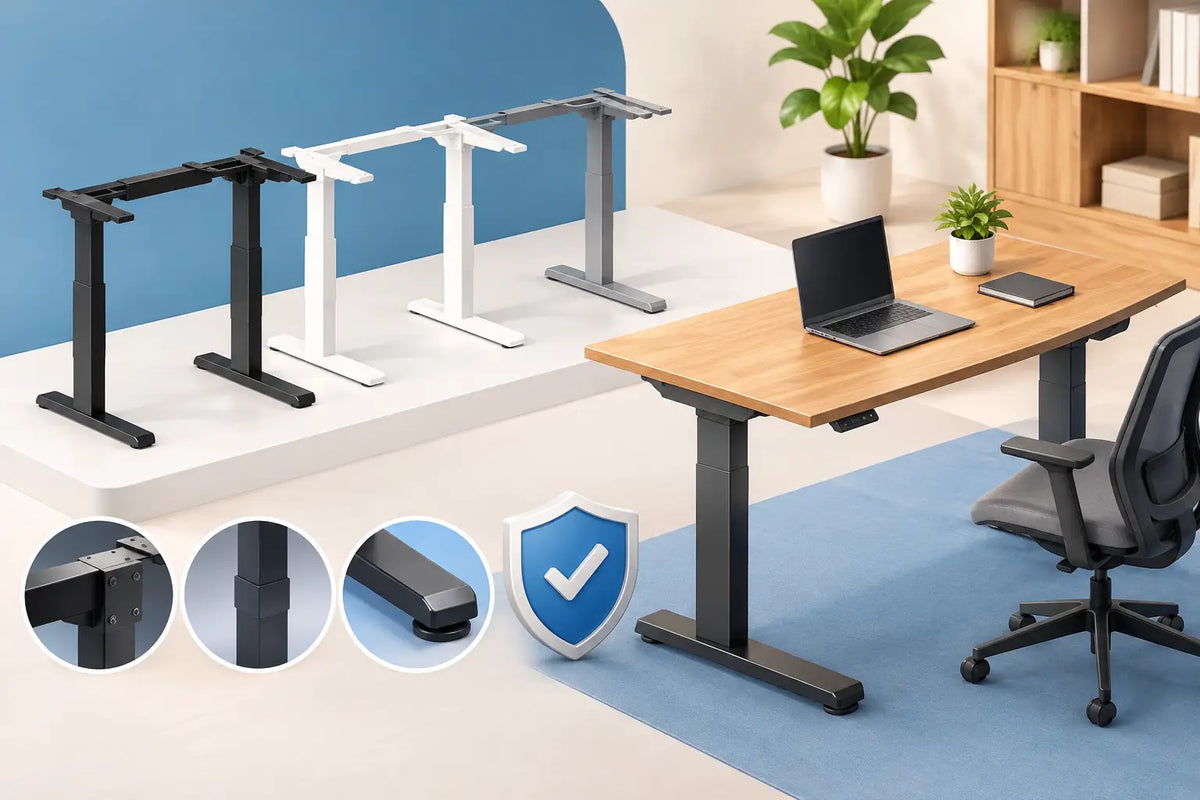
The frame's steel construction, leg profile, foot length and crossbar design all contribute to its steadiness. Heavier-gauge steel and well-engineered joints generally provide a more planted feel than lightweight, simplified bases. A broader foot can also improve stability, although it must still work with the room and allow comfortable chair movement.
There is a practical trade-off here. A frame designed for maximum rigidity can be visually more substantial than a minimalist alternative. For most premium home offices, that is a worthwhile exchange. The frame should disappear into the overall design, but it should never feel insubstantial beneath a thick oak top.
Test stability at the height you will actually use
Many buyers assess a frame at seated height, where nearly every desk feels stable. Standing height is the real test. If you are tall, work with several screens or use a monitor arm, prioritise a frame known for control at the upper end of its travel.
Your floor matters too. Uneven timber boards, soft rugs and old floor surfaces can amplify movement. Adjustable levelling feet help the desk sit properly, while a floor protector can provide a more even base and protect the surface beneath it.
Prioritise a useful height range
The correct desk height is not a fixed number. It depends on your body, footwear, chair, keyboard position and whether you alternate between sitting and standing. A good frame should travel low enough for comfortable seated work and high enough for an upright standing posture without raised shoulders.
At seated height, your elbows should rest close to a 90-degree angle while your shoulders remain relaxed. When standing, the same principle applies: your keyboard should meet you, rather than making you bend toward it or lift your arms.
If more than one person will use the desk, a generous height range becomes even more valuable. It allows each person to save an appropriate position and prevents the desk from becoming a compromise built around only one body. This is where electric adjustment earns its place. A desk that changes position easily is a desk you are more likely to use ergonomically.
Select dual motors for a heavier, premium setup
For a compact and lightly loaded desk, a single-motor frame can be sufficient. But solid oak tops, broad workstations and accessory-rich setups benefit from the power and balance of a dual-motor system.
Dual motors typically distribute lifting work across both legs, helping the desk rise and lower evenly under load. The movement should feel controlled rather than strained, particularly when the desk is carrying the objects that make your workspace functional every day.
Look beyond the simple presence of motors. Consider lifting capacity, travel speed and noise. A high stated capacity offers useful headroom, but the figure only matters when the frame is properly designed throughout. Quiet operation matters more than it may seem. If the desk moves with a harsh mechanical sound, you may avoid changing position during calls or when others are nearby.
A memory control panel is a small detail with a meaningful effect. Saving seated and standing heights removes friction from the habit of moving. Some systems also offer a gentle reminder function, which can be useful for people who become absorbed in focused work and forget to change posture.
Understand how to choose desk frame proportions
A desk frame should suit the visual and physical proportions of the top. A narrow frame beneath an oversized tabletop can look awkward and may leave too much unsupported overhang. A frame set too wide can interfere with seating position, storage or cable routing.
As a general rule, keep the legs sufficiently inset from the edges to create a balanced appearance while allowing the frame to support the useful working area. The exact placement depends on top dimensions and the frame's adjustment range. Longer tops need particular attention, as they can encourage users to place weight near the outer edges.
Depth deserves the same care. A 60 cm deep desk may suit a laptop-focused setup, but a deeper top gives monitors, keyboards and writing space more room to breathe. The frame needs to accommodate that depth without bringing its feet uncomfortably close to where your chair naturally rolls.
Check load capacity honestly
Load capacity should include everything that stays on the desk: the tabletop, screens, monitor arms, computer equipment, lamps, speakers and everyday working tools. Do not treat the quoted maximum as the ideal daily operating weight. A frame performs best when it has a sensible reserve rather than working at its limit.
Solid European oak is a long-term material, and it makes sense to pair it with a base designed for the same lifespan. Choosing a stronger frame now is often less expensive than replacing an underpowered one when your workspace grows.
This is particularly relevant for wide desks. The top itself may be the heaviest part of the installation, before a single piece of technology is added. A frame with generous capacity protects both performance and peace of mind.
Look for safety and cable details
A refined workspace should work cleanly behind the scenes. Cable management is not merely decorative. It prevents wires from catching as the desk moves and makes the area easier to clean, maintain and reconfigure.
Choose a frame with a considered route for the control box and motor cables, then plan for a cable tray or management solution beneath the top. Leave enough slack for the full height range, but avoid loops that hang low or snag on drawers and chair arms.
Anti-collision technology is another detail worth having. If the desk meets an obstacle while moving, the system can stop or reverse to reduce the risk of damage. It is especially useful in compact rooms, shared spaces and homes where a chair, storage unit or armrest may occasionally be left in the wrong place.
Consider the finish as part of the room
Black, white and more neutral steel finishes each create a different relationship with oak. A black frame gives the desk a crisp architectural contrast and often suits darker monitors and accessories. White can make a workspace feel lighter and less visually dense. A muted metallic tone can offer a softer, more workshop-inspired expression.
The right choice depends on the room as much as the desk. Consider flooring, wall colour, storage and lighting. Oak brings warmth and natural variation, so the frame can either sharpen that character with contrast or support it with a quieter palette.
At OAKO, the most convincing desks are not assembled as unrelated parts. The oak top, steel base, chair, monitor placement and cable management are considered as one working environment. That is how a desk becomes a place you want to return to.
Do not overlook assembly and serviceability
Even an excellent frame can disappoint if it is difficult to install or hard to maintain. Clear instructions, properly labelled components and well-positioned fixing points make a noticeable difference, especially with a heavy solid wood top that deserves careful handling during assembly.
Think ahead about access to the control box, cables and feet. Components may rarely need attention, but they should not be impossible to reach if your setup changes. A frame with replaceable electronic parts and a meaningful warranty is a stronger long-term choice than one built as a disposable unit.
Your desk should encourage better work without asking for attention. Choose a frame that is steady under pressure, proportioned for your oak top and easy to adjust when your day changes. Then let the material above it do what real oak does best: bring warmth, character and a sense of permanence to the hours you spend creating.

Zostaw komentarz
Ta strona jest chroniona przez hCaptcha i obowiązują na niej Polityka prywatności i Warunki korzystania z usługi serwisu hCaptcha.