


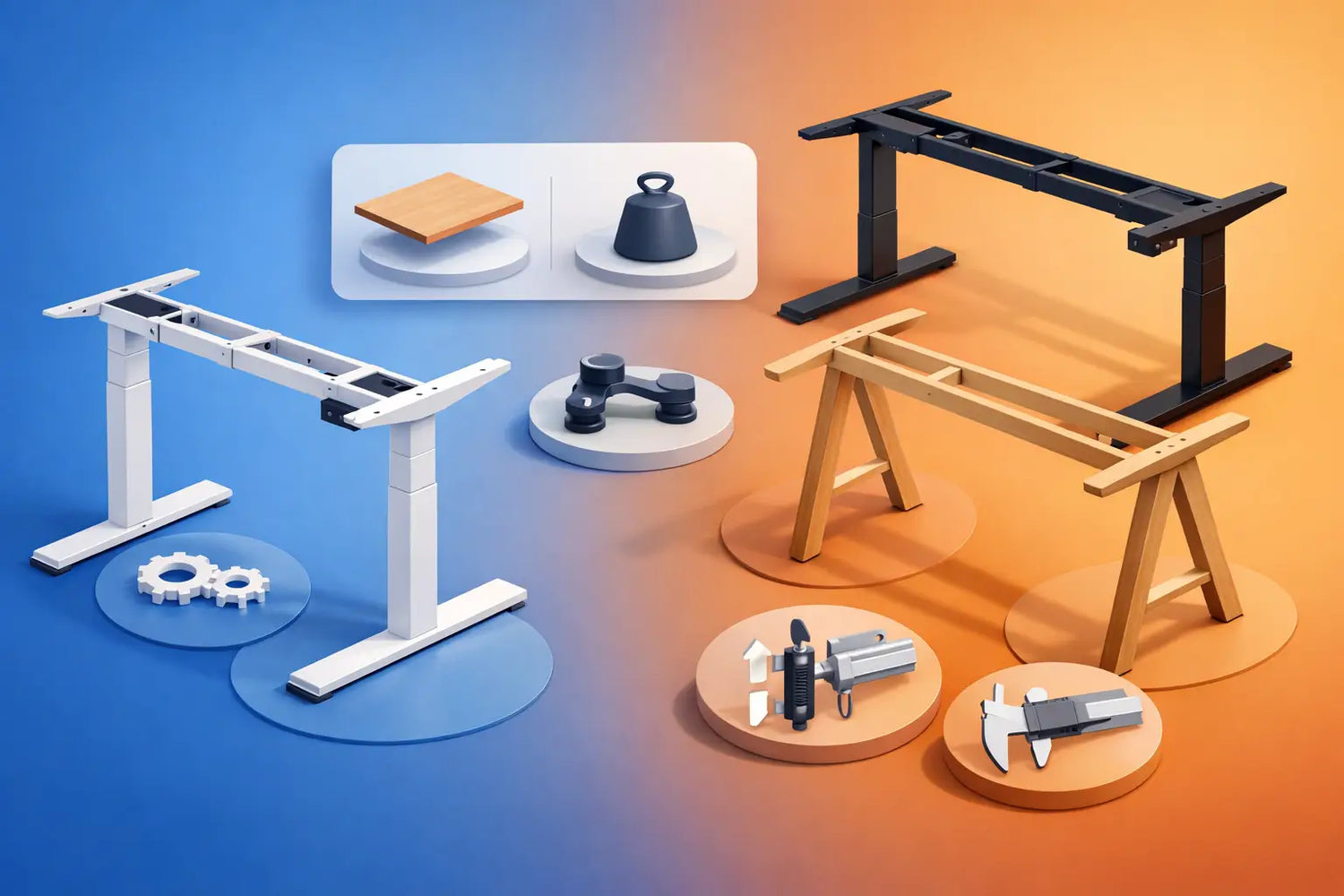
A desk frame comparison can look deceptively simple: two legs, a control panel, a choice of black or white. But the frame is the working mechanism beneath your desk, and it decides whether a height-adjustable workspace feels calm and dependable or slightly compromised every day. It carries the weight of your tabletop, screens, monitor arms and equipment. It also determines how confidently the desk performs at standing height.
For a desk intended to stay with you for years, especially one paired with a substantial solid oak top, the frame deserves more attention than a product thumbnail can give it. The right choice is not simply the frame with the longest feature list. It is the one whose engineering suits your work, your room and the material weight above it.
Desk frame comparison starts with stability
Stability is the quality you notice without looking for it. When you type at full height, adjust a screen or rest an elbow on the desktop, the desk should feel composed. Some movement is normal in any raised structure, but a well-designed frame keeps that movement controlled rather than distracting.
The frame’s leg construction has a large influence here. Telescopic lifting columns are commonly built with two or three sections. Three-stage columns usually offer a broader height range, making them a practical choice for both shorter and taller users. Their narrower lower sections can also demand careful engineering to remain steady at the top of their travel. The number of stages alone is not a verdict on quality. Look at the complete construction: the column profiles, steel thickness, crossbeam design and the width of the feet all work together.
A wide stance gives the desk a stronger foundation. Feet should extend far enough to resist forward and backward movement without becoming a constant obstacle under the desk. This matters in compact Danish homes, where a desk may sit close to a wall, radiator or shelving. Measure the room, but also consider where your feet, chair and cable routes will actually go.
The tabletop changes the equation. A thick oak surface has genuine mass, which contributes to a grounded feel, yet it asks more of the lifting mechanism than a light chipboard top. Pairing real wood with a properly specified steel frame is not an indulgence. It is good furniture logic.
Why standing-height stability matters more
Many frames feel perfectly acceptable while seated. The true test is near your preferred standing height, with your daily equipment in place. A laptop alone is one thing. Two monitors on an arm, a desktop computer, speakers and a solid wood top create a different load and a different centre of gravity.
If you work with detailed layouts, edit video, sketch, trade or write for long stretches, screen movement can break concentration. This is where a stable frame earns its place. It lets the desk become part of the room rather than another object demanding your attention.
Single motor or dual motor?
This is often the clearest decision in a desk frame comparison. A single-motor frame uses one motor to drive both legs through a mechanical system. A dual-motor frame places a motor in each lifting column, allowing each side to work directly.
Single-motor frames can be suitable for lighter setups and occasional height adjustment. They are often less expensive and can serve a straightforward home office well. The trade-off is usually lower lifting capacity, less power under load and more components transferring force across the frame.
A dual-motor frame is the more natural choice for a premium desk built around solid oak. It provides more even lifting, higher carrying potential and greater confidence for a fully equipped workstation. It also makes sense for people who genuinely alternate between sitting and standing several times a day. The point is not to chase technology for its own sake. It is to choose a mechanism that will not feel underpowered as your workspace develops.
Motor count should still be considered alongside build quality. Two motors in a lightly built frame do not automatically outperform a thoughtfully engineered single-motor alternative. But where substantial materials, regular movement and long-term use are priorities, dual motors are a sound baseline.
Load capacity is not just a headline number
A frame’s quoted load capacity should cover the full working surface: tabletop, monitors, arms, computer, desk lamp, drawers and everything else that remains on the desk while it moves. Do not compare this figure to the weight of your laptop alone.
It is wise to leave a meaningful margin rather than operate near the stated maximum. A frame that is comfortably capable of carrying your setup will generally lift with less strain and retain a more assured feel. This is especially relevant when choosing a large desktop or a live-edge oak top, where shape and thickness add both character and weight.
Also ask how you use the desk. A creative workstation with studio monitors and a heavy display is different from a laptop-based setup. A 160 cm desktop intended for multiple screens is different from a compact 120 cm desk in a bedroom. Capacity should support the reality of the room, not an empty-desk specification.
The crossbeam and desktop width
Most adjustable desk frames use an expandable crossbeam that adapts to different tabletop widths. This creates flexibility, but it should not become an excuse for a poor match. A frame needs to sit correctly beneath the top, with enough support across its span and sensible inset from the edges.
A very wide tabletop on a narrow frame can look unbalanced and may feel less planted, especially when weight is placed near the corners. Conversely, an oversized frame beneath a compact desk can interfere with knee clearance or the visual restraint that makes a small workspace feel calm.
Choose the top and frame as one piece of furniture. This is one reason coordinated desks tend to feel more resolved than an assortment of parts bought separately.
Height range should fit the person, not the average
A height-adjustable desk only improves ergonomics when it reaches the right positions for your body. At seated height, your forearms should meet the work surface comfortably without lifted shoulders. At standing height, the same principle applies, with your screen and keyboard placed to support a neutral posture.
A generous height range is useful for tall users, shared households and offices where several people use the same desk. Lower minimum heights matter too, particularly for shorter users or anyone who prefers a lower seated position. If you share a desk with a partner, children or colleagues, a wider range makes the desk substantially more useful.
The controller affects whether you take advantage of that range. Memory presets remove friction from changing position. One press is enough to move from focused seated work to a standing call. A simple handset can be perfectly adequate, but presets make the ergonomic intention easier to maintain during a busy day.
Controls, safety and the details that last
A good frame should move smoothly and at a measured pace. Extremely fast movement is rarely necessary; controlled operation and reliable synchronisation matter more. The sound level also deserves consideration in an open-plan home or a shared office, where a loud mechanical rise can become surprisingly noticeable.
Anti-collision protection is a valuable practical feature. If the desk meets an obstacle while moving, such as an armrest, storage unit or cable basket, it should stop and reverse. No safety system replaces sensible setup, but it adds reassurance in active family homes and busy workspaces.
Cable management is equally part of the frame decision, even if it is not built into the legs themselves. A rising desk needs enough slack and a deliberate route for power, charging and monitor cables. Without it, the clean line of an oak desktop is quickly lost beneath a tangle of wires. Plan for a cable tray, power strip placement and monitor-arm routing from the beginning.
Finish is the final visual consideration. Black steel creates a graphic contrast beneath natural oak and suits darker, more architectural interiors. White feels lighter and can soften a smaller room. Neither is objectively better. The strongest choice is the one that relates to the rest of the workspace: chair base, monitor arm, lighting and storage.
Choose the frame for the desk you will keep
The least expensive frame may meet a short-term need. Yet a desk is touched more than most furniture: every morning, every call, every late evening when work becomes personal. If you have chosen a tabletop with grain, depth and honest material character, the mechanism beneath it should carry the same sense of intention.
OAKO pairs handcrafted European oak with steel dual-motor frames because the desk should feel as considered in motion as it does at rest. That combination suits a workspace designed around longevity rather than replacement.
Before deciding, picture your desk at its busiest: screens raised, cables connected, coffee nearby, a full day ahead. Choose the frame that remains quiet, stable and capable in that moment. The best one will not compete for your attention. It will simply make room for better work.



Leave a comment
This site is protected by hCaptcha and the hCaptcha Privacy Policy and Terms of Service apply.