


A standing desk has a quiet job: it should move a substantial work surface, your screens, equipment and daily clutter without asking for attention. That is why the dual motor versus single motor question matters most when the desk is carrying real weight - particularly a solid oak top that is built for decades, not a few years.
The short answer is that a dual-motor frame is usually the stronger choice for a premium, heavily used sit-stand desk. But motor count alone does not define quality. Frame construction, lifting columns, control electronics and the weight on the desk all shape how a desk feels from the first adjustment to its thousandth.
How a single-motor standing desk works
A single-motor desk uses one motor to raise both legs. In many designs, that motor transfers power across the frame through a driveshaft, gearbox or cable system. It is an efficient arrangement and, on a well-made desk with a modest load, it can provide dependable everyday movement.
The appeal is straightforward: fewer powered components can mean a lower purchase price and a simpler construction. For a compact home office setup with a laptop, one monitor and a light tabletop, a quality single-motor frame can be entirely appropriate.
Its limitation becomes clearer as the desk gets wider, heavier or more heavily equipped. One motor is responsible for moving the full load and keeping both sides of the desk travelling together. The connecting mechanism must also do its work precisely. Over time, wear, imperfect assembly or an uneven load can make that system more noticeable in the form of slower travel, a slightly less composed movement or greater strain at the upper end of its capacity.
That does not make every single-motor desk a poor desk. It simply means its best use case is a lighter, lower-demand workstation.
Dual motor versus single motor: the practical difference
A dual-motor frame places a dedicated motor in each lifting leg. Both sides of the desk receive direct power, coordinated by the control box. Instead of relying on one motor and a mechanical transfer system to move the entire frame, each column shares the work.
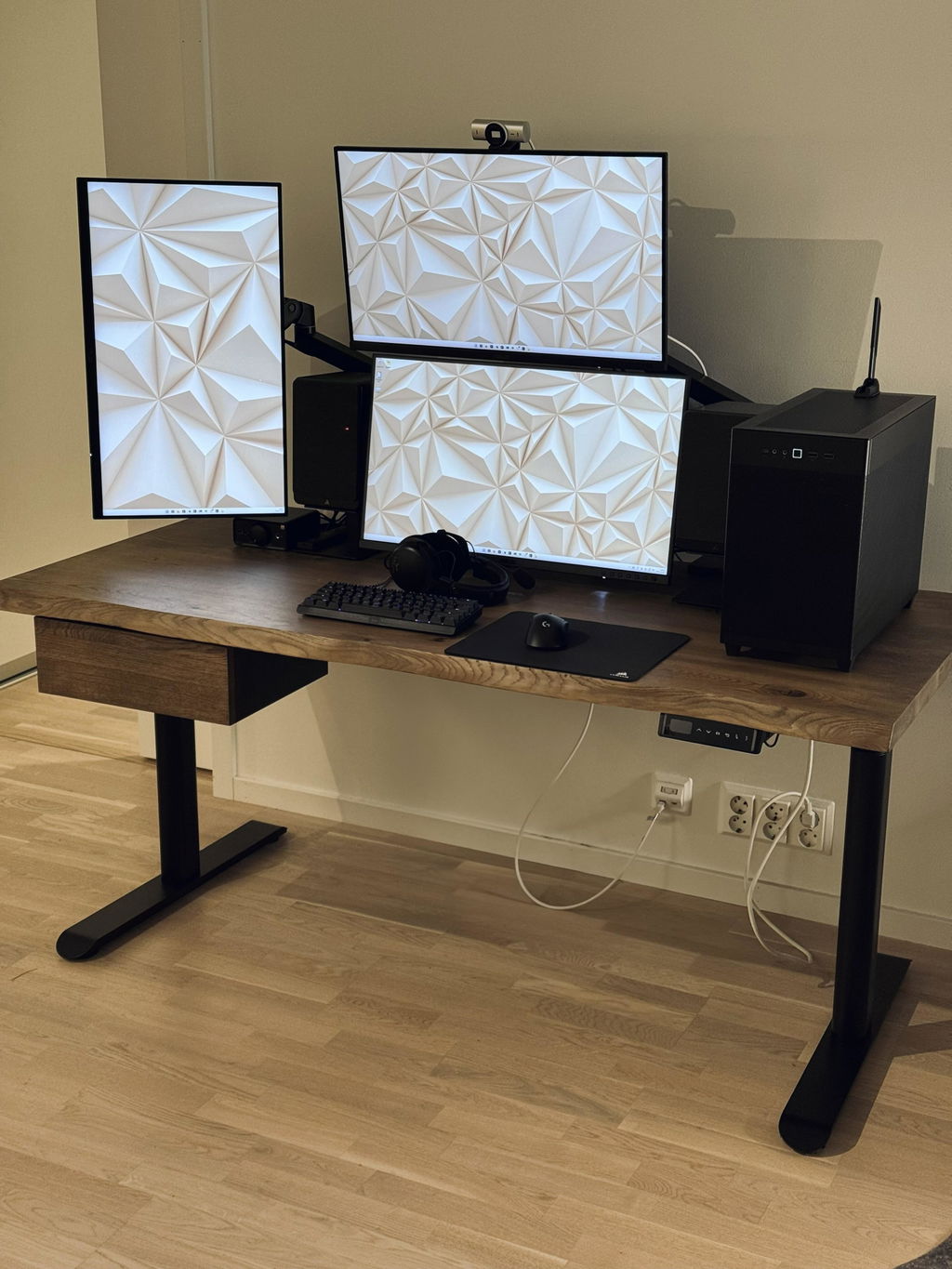
For the person using the desk, the benefit is not a dramatic feature to show off. It is the composed feeling of pressing a button and seeing a substantial desk rise evenly, even when it holds multiple monitors, a desktop computer, speakers, books and a solid wood top.
Dual motors generally offer a higher lifting capacity, faster adjustment and more consistent motion under load. They also give the frame more headroom. A desk should not spend its life working at the edge of what it can handle. Capacity in reserve supports smoother movement and reduces unnecessary stress on the mechanical parts.
This is particularly relevant for solid oak. Oak brings warmth, grain and a depth that laminate cannot imitate, but authentic material has real mass. A thick solid oak desktop deserves a frame engineered to carry it with confidence. Pairing a substantial top with an underpowered base compromises the experience that the material is meant to create.
Stability is not just about the number of motors
Motor count and stability are often grouped together, but they describe different things. Motors determine how the desk lifts. Stability is largely determined by the frame's steel construction, leg profile, column overlap, foot design, crossbar engineering and the precision of its joints.
A dual-motor frame can still feel disappointing if its legs are thin, its feet are too short or its tolerances are poor. Equally, a thoughtfully engineered single-motor frame may feel firm at a seated height. The real test comes when the desk is raised to standing height, where any weakness in the structure becomes more obvious.
Look for a frame that feels planted rather than merely upright. At standing height, normal keyboard work should not create an unsettled side-to-side motion. A monitor should remain calm when you type. Some movement is natural in any height-adjustable structure, especially with a tall desk and a monitor arm, but the desk should feel controlled rather than fragile.
A heavier solid wood top can help a frame feel grounded, although it also increases the load the lifting system must manage. This is another reason the entire desk should be specified as a system, not assembled from attractive but mismatched parts.
Lifting capacity is useful only when read honestly
A quoted weight capacity can make comparisons easier, but it should be treated as a starting point rather than the whole story. Ask what will actually live on the desk: the tabletop itself, monitor arms, displays, computer hardware, desk lamps, charging equipment and the occasional stack of papers that never quite leaves.
Then leave meaningful margin. A frame rated just above your calculated load may technically function, but a premium desk should have room to work without strain. The extra capacity in a dual-motor system becomes valuable for people who use ultrawide displays, dual-monitor configurations, studio equipment or a large oak surface.
The distribution of that load matters too. A heavy desktop computer placed at one far corner, combined with monitor arms extended forward, creates a different demand from the same weight spread evenly across the desktop. Good habits help: keep the heaviest items close to the centre of the desk, make sure the feet sit level on the floor, and avoid storing heavy boxes beneath a desk that needs to travel down.
Speed, noise and daily feel
Most people adjust their desk only a few times a day. That makes movement speed less critical than a clean, predictable operation, though a faster lift is still welcome when switching between meetings and focused work.
Dual-motor desks often lift more quickly because two motors are sharing the load. They may also sound more assured under a heavier setup. Yet quieter is not automatically better if quietness comes with slow, strained movement. A well-built frame should make a restrained mechanical sound, move at an even pace and stop without jolting.
Control quality deserves attention here. A responsive handset with saved height positions makes alternating between sitting and standing more likely to become a real habit. Anti-collision protection is equally valuable in a home office where a chair arm, drawer unit or curious child can end up in the desk's path. These features are not exclusive to dual-motor frames, but they are part of the complete experience worth expecting from a serious workspace.
Longevity depends on how the desk is used
A motor is only one component in a height-adjustable desk. The durability of lifting columns, gears, cables, control box and handset matters just as much. So does the quality of the desktop, where a solid oak surface can be repaired, refinished and appreciated as it develops character over time.
That said, a dual-motor frame has an advantage in demanding conditions because each motor carries less of the overall lifting work. For a desk raised and lowered regularly with a substantial setup on top, this division of labour is sensible engineering.
For occasional use with a simple laptop setup, the financial case for dual motors is less absolute. A single-motor desk can serve well if it comes from a manufacturer that has not cut corners in the columns and steelwork. The decision is about matching the mechanism to the life you expect the desk to lead.
Which frame suits your workspace?
Choose a single-motor desk when the surface is compact, the equipment is light and the desk will not be adjusted constantly. It can be a practical solution for a secondary workstation, student room or minimal setup where budget carries more weight than expansion capacity.
Choose a dual-motor desk when you want a larger desktop, multiple screens, a monitor arm, a desktop computer or the enduring substance of solid oak. It is also the more fitting choice if your desk is the centre of your working day and you expect it to remain there through changing roles, equipment and homes.
For design-conscious workspaces, the answer often goes beyond specifications. A standing desk should feel as considered underneath as it looks above. At OAKO, this is why solid European oak is paired with steel dual-motor frames: natural material and purposeful technology should support one another, not compete.
The best desk is not the one with the longest feature list. It is the one that makes a change of posture effortless, holds your work without hesitation and still feels worthy of its place in the room years from now.


Laat een reactie achter
Deze site wordt beschermd door hCaptcha en het privacybeleid en de servicevoorwaarden van hCaptcha zijn van toepassing.