



A desk can be beautifully made and still feel misplaced if every surrounding piece speaks a different visual language. Learning how to match office furniture is less about buying an identical set and more about creating a considered relationship between material, proportion, colour and function. The result should feel calm at first glance, then prove itself through the working day.
For a home office, that balance matters even more. Your workspace often shares a room with the rest of your life. It needs to support deep work, video calls and movement without making the space feel clinical, crowded or temporary.
Start With One Anchoring Material
The strongest offices usually begin with one material that sets the tone. A solid oak desktop is a natural anchor: it brings depth, grain and warmth that can carry the room without asking for excessive decoration. Once oak is the central surface, the rest of the furniture should support it rather than compete with it.
This does not mean every item must be oak. In fact, too much matching timber can make a workspace feel heavy or overly coordinated. Let oak lead on the largest surface, then repeat it in smaller, quieter moments: a shelf, drawer front, monitor stand or picture frame. Repetition creates cohesion, while variation keeps the room alive.
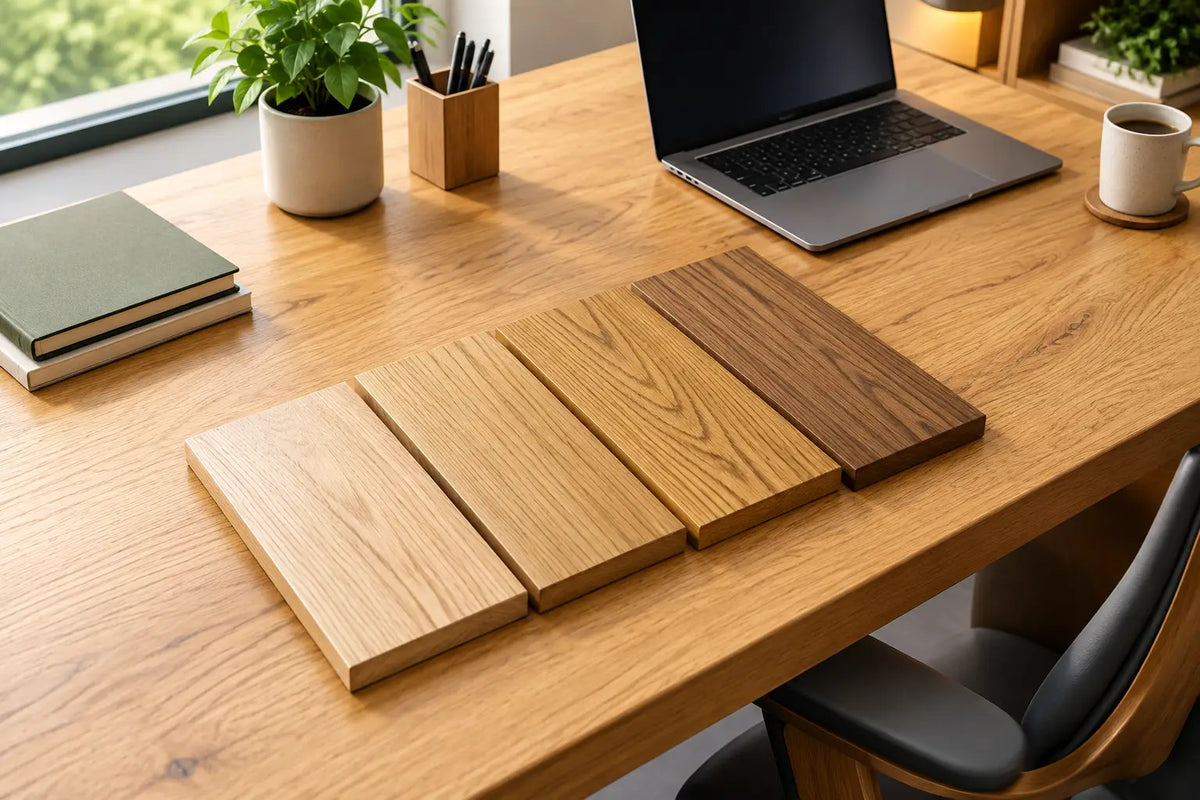
Pay attention to undertones. European oak can range from pale and clean to more golden and expressive, depending on the finish and grain. If you are pairing an oak desk with existing furniture, compare samples in the room itself. Daylight changes wood dramatically, and a warm floor or cool wall paint can alter how the same timber appears.
Match the Desk Frame to the Room's Lines
A standing desk frame is not only an ergonomic mechanism. It is a visible architectural element. Its colour, profile and visual weight should relate to the room's other lines, especially chair bases, storage legs, lamps and monitor arms.
Black powder-coated steel is a reliable partner for oak because it gives the timber a crisp edge. It works particularly well in rooms with black window frames, dark lighting, charcoal textiles or a black ergonomic chair. The contrast is intentional: natural warmth above, technical precision below.
White frames create a lighter, more understated expression. They suit pale walls, soft neutral interiors and smaller rooms where you want the desk to recede rather than dominate. The trade-off is that white can look less grounded beside very dark storage or strong industrial details. If the room already has several black elements, a black frame will usually make the composition feel more resolved.
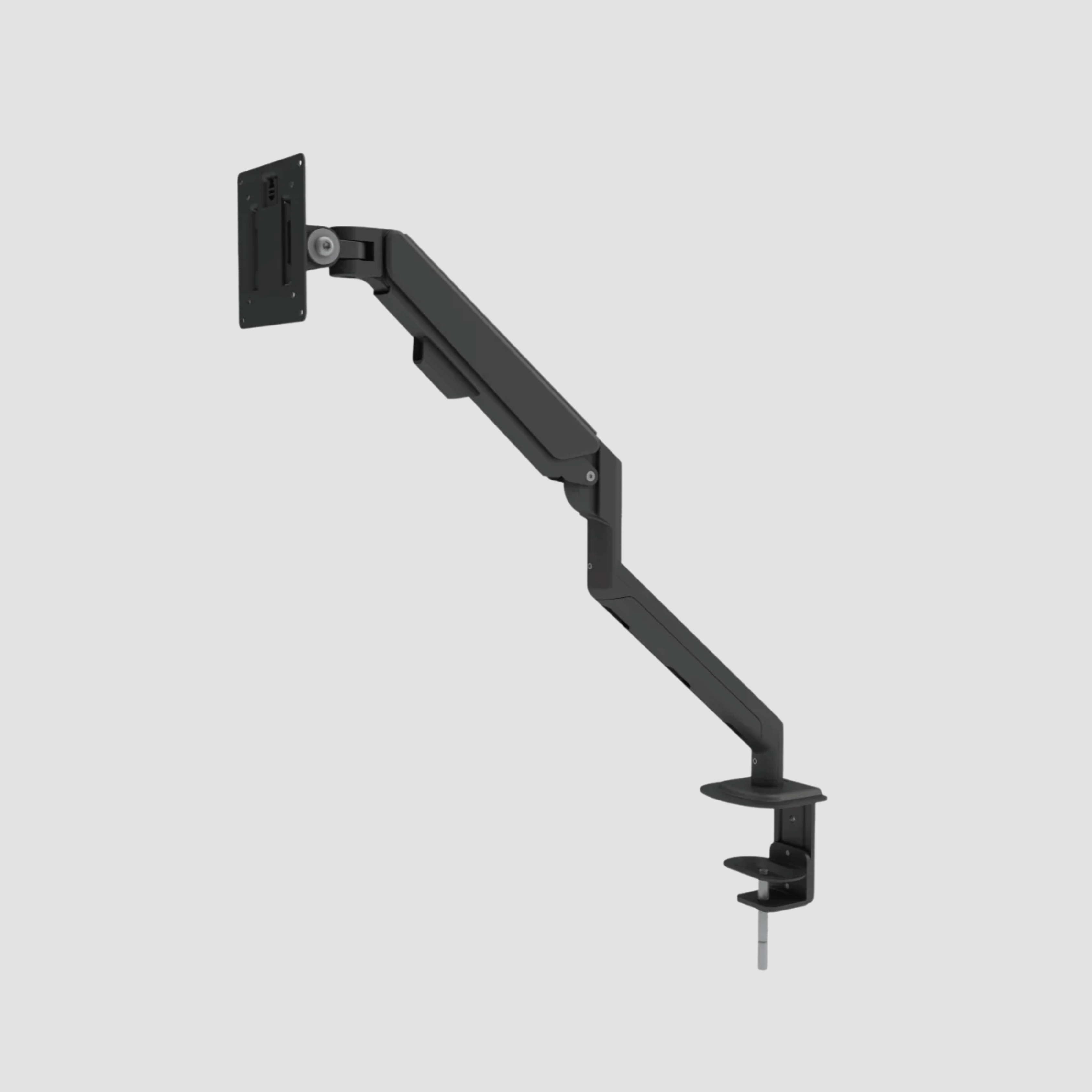
Try to repeat the frame colour at least twice elsewhere in the room. A black desk frame paired with a black monitor arm and lamp, for example, reads as a deliberate system rather than a collection of separate purchases.
Build Around Scale, Not Just Style
Office furniture can share a colour palette and still look wrong if its proportions are unrelated. A substantial solid wood desk needs supporting pieces with enough presence to hold their own. A slim, lightweight chair beside a thick oak top may look visually timid, while a large storage cabinet can overwhelm a compact work area.
Begin with the desk as the largest working surface, then assess the furniture around it by height and mass. Low storage generally works best when it sits below the desk line or clearly above it, rather than stopping at an awkward near-match. Shelving should leave enough clear wall around it to breathe. In a small room, one well-proportioned cabinet is often more convincing than several narrow units.
Ergonomics should guide these decisions too. Your chair needs enough clearance to move freely. A monitor should sit at a comfortable height without forcing the desk into visual clutter. Cable trays, power units and desk accessories are most successful when they disappear into the overall structure.
Leave Space for Movement
A height-adjustable desk changes the requirements of the room. When the desktop rises, there must be space for the chair, cables and nearby furniture to remain unobstructed. Avoid placing tall cabinets immediately beside the desk if they make the standing position feel boxed in.
This is where matching becomes practical rather than decorative. A workspace that looks composed but prevents you from changing posture is not truly well designed. Build enough breathing room around the desk for the room to work with you.
Choose a Controlled Colour Palette
A useful rule is to work with three dominant finishes: the timber, one metal or neutral base colour, and one softer accent. This gives the room enough contrast to feel designed, without turning every object into a statement.
With oak and black steel, muted green, warm grey, clay, deep blue and off-white all work well as accent colours. They bring character while allowing the grain to remain visible. For a softer Scandinavian-adjacent look, pair pale oak with sand, linen, mushroom and brushed aluminium. For more contrast, use oak with black, tobacco leather and a single saturated textile.
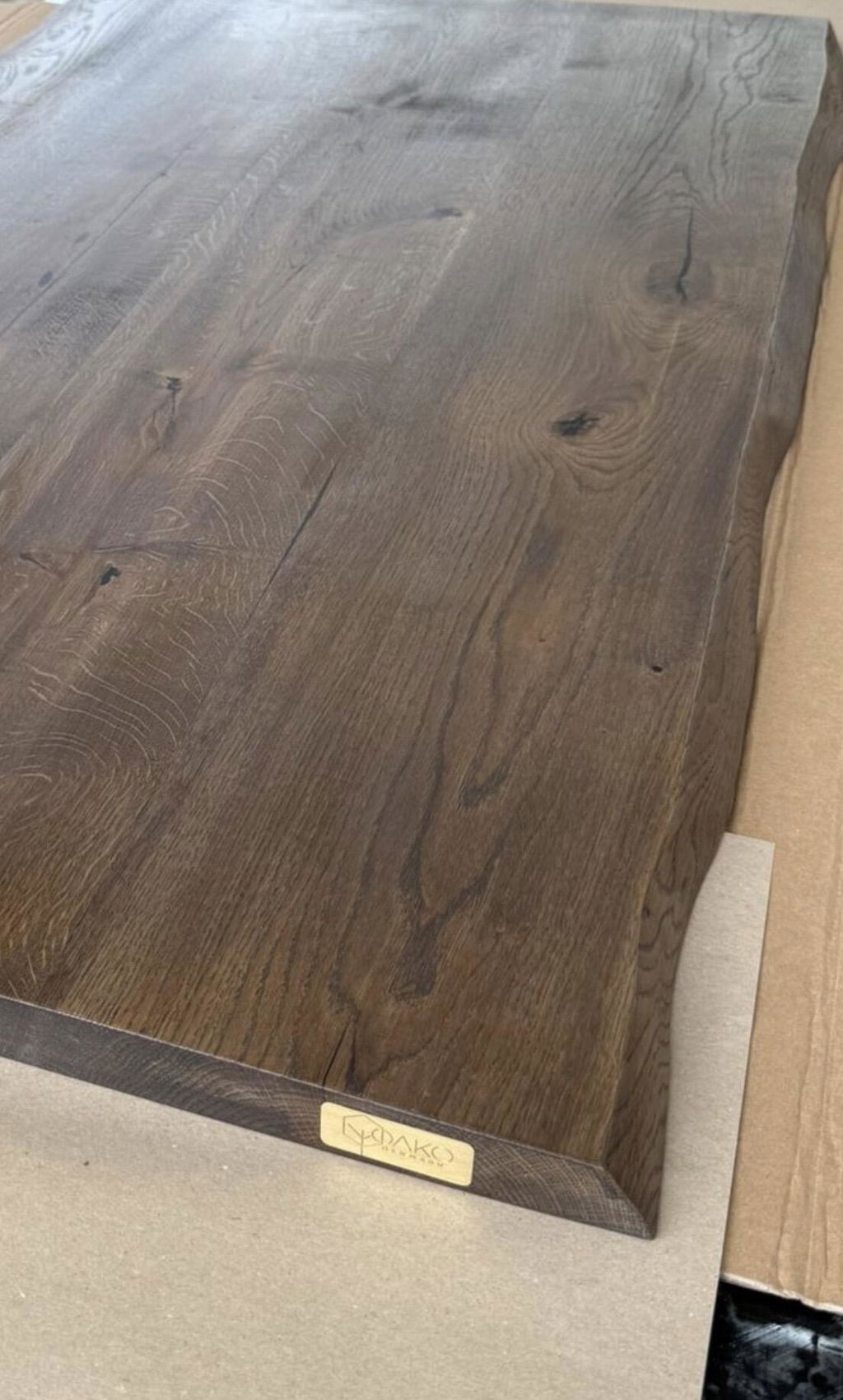
Be careful with competing wood tones. A walnut cabinet, red-toned teak floor and honey oak desk may each be attractive individually, but together they can make the room feel unsettled. You can combine woods successfully when the contrast is clear and repeated with purpose. A pale oak desk against a dark walnut sideboard, for example, can work if black or neutral details connect them. Near-matches are harder than confident contrasts.
Let the Chair Belong Without Disappearing
The office chair is often the most technical object in the room, and it should not be treated as an afterthought. It needs to support long hours of focused work, yet its material and silhouette affect the whole composition.
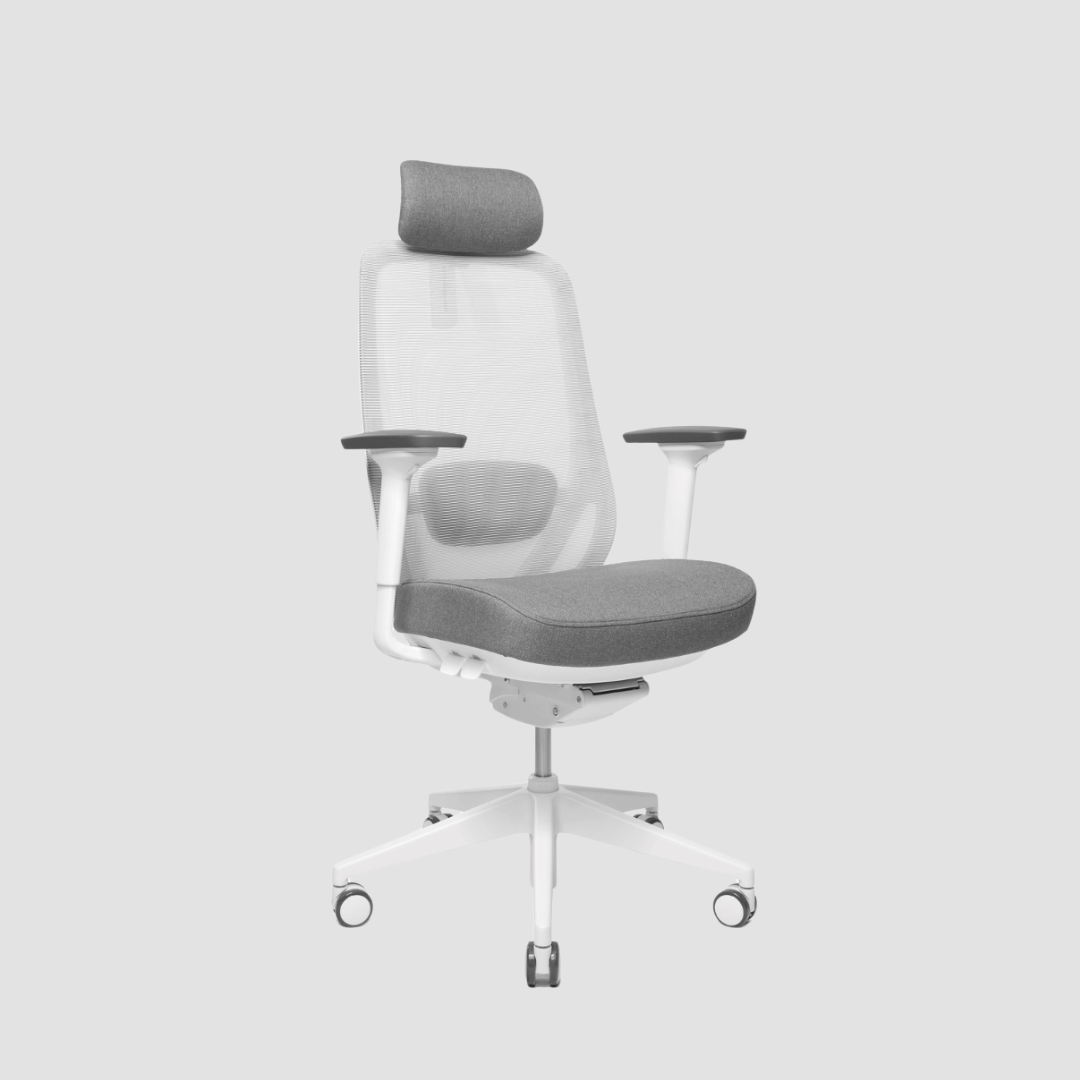
A black ergonomic chair is the most versatile choice beside an oak standing desk. It echoes a black steel frame, hides the complexity of adjustment mechanisms and gives the desk a clear visual foundation. A light grey or beige chair can be equally effective in an airy interior, especially with a white frame or pale flooring.
Leather brings warmth and tactility, but it needs balance. A leather chair can make an office feel more residential and established, particularly in a study or creative workspace. Choose it when you value patina and character. Choose a technical fabric or mesh chair when breathability, adjustability and a lighter visual profile are the priority. There is no universal answer: the right chair depends on how many hours you sit and whether the room should feel more like a studio, a library or a clean modern work zone.
Treat Accessories as Part of the Furniture
Monitor arms, cable management and desk storage may be small, but they determine whether the finished office feels crafted or improvised. Matching these components is one of the simplest ways to make mixed furniture feel intentional.
Keep metals consistent where possible. If the desk frame is black, choose a black monitor arm, cable tray, drawer hardware and lamp base. If you prefer a lighter scheme, white and aluminium accessories can create a quieter technical language. A few visible finishes are enough. Five different metal tones rarely look collected; they look accidental.
Consider what stays on the desktop, too. A solid oak surface deserves to remain visible. Give everyday objects a defined home: a discreet tray for small tools, a stand for headphones, a dock for charging and cable routing beneath the top. The aim is not an empty desk for photographs. It is a desk that can be used fully without losing its sense of order.
At OAKO, the strongest workspace combinations are built as a family of useful objects: real oak where the hand meets the surface, dependable steel where the structure needs strength, and ergonomic tools where the body needs support.
Match for Longevity, Not for a Moment
Trends can be useful references, but office furniture is asked to work for years. Avoid matching through novelty alone, such as a bold chair colour or a highly specific decorative finish that you may tire of quickly. Put lasting materials and essential performance first, then express personality through items that are easy to change: artwork, a plant, a desk mat or textiles.
This approach also makes investment more sensible. A thick solid oak desktop develops character with use. A quality chair and dual-motor frame continue to earn their place long after a seasonal colour trend has passed. When the core pieces are honest and durable, you can refresh the room without replacing its foundation.
Before making the final choice, stand back from the room and look for a simple rhythm: wood repeated with restraint, metal repeated with purpose, clear surfaces and enough room to move. If the workspace makes you want to sit down, stand up and return to it tomorrow, the furniture is not merely matched. It belongs.

Lämna en kommentar
Denna webbplats är skyddad av hCaptcha och hCaptchas integritetspolicy . Användarvillkor gäller.