




A desk is one of the few pieces of furniture asked to perform every day. It carries screens, notebooks, coffee, cables and the weight of long working hours. When comparing solid wood versus veneer desks, the visible surface is only part of the decision. What sits beneath it shapes how the desk feels, ages, moves and earns its place in your workspace.
For a home office built around focus and longevity, material choice deserves more attention than a product photo can provide. Both solid wood and veneer can look beautiful. Both can be used well. But they are made differently, behave differently over time, and suit different priorities.
Solid Wood Versus Veneer Desks: The Core Difference
A solid wood desk top is made from real timber throughout its thickness. Individual boards are selected, joined and finished to create one substantial surface. In oak, this means the grain, colour variation and natural character run beyond the top layer. The material is honest all the way through.
A veneer desk has a thin layer of real wood applied over a core. That core may be plywood, MDF, particleboard or another engineered board. Veneer is not automatically a poor-quality material. Fine furniture makers have used it for centuries, often to create precise patterns or make efficient use of rare timber. The quality depends on the veneer thickness, the core, the adhesive, the edge treatment and the care taken in production.
The distinction matters most once the desk becomes part of real life. A top can look like oak on day one, yet respond very differently to a knock, a move across the room, a change in humidity or ten years of daily use.
How Each Material Feels at Work
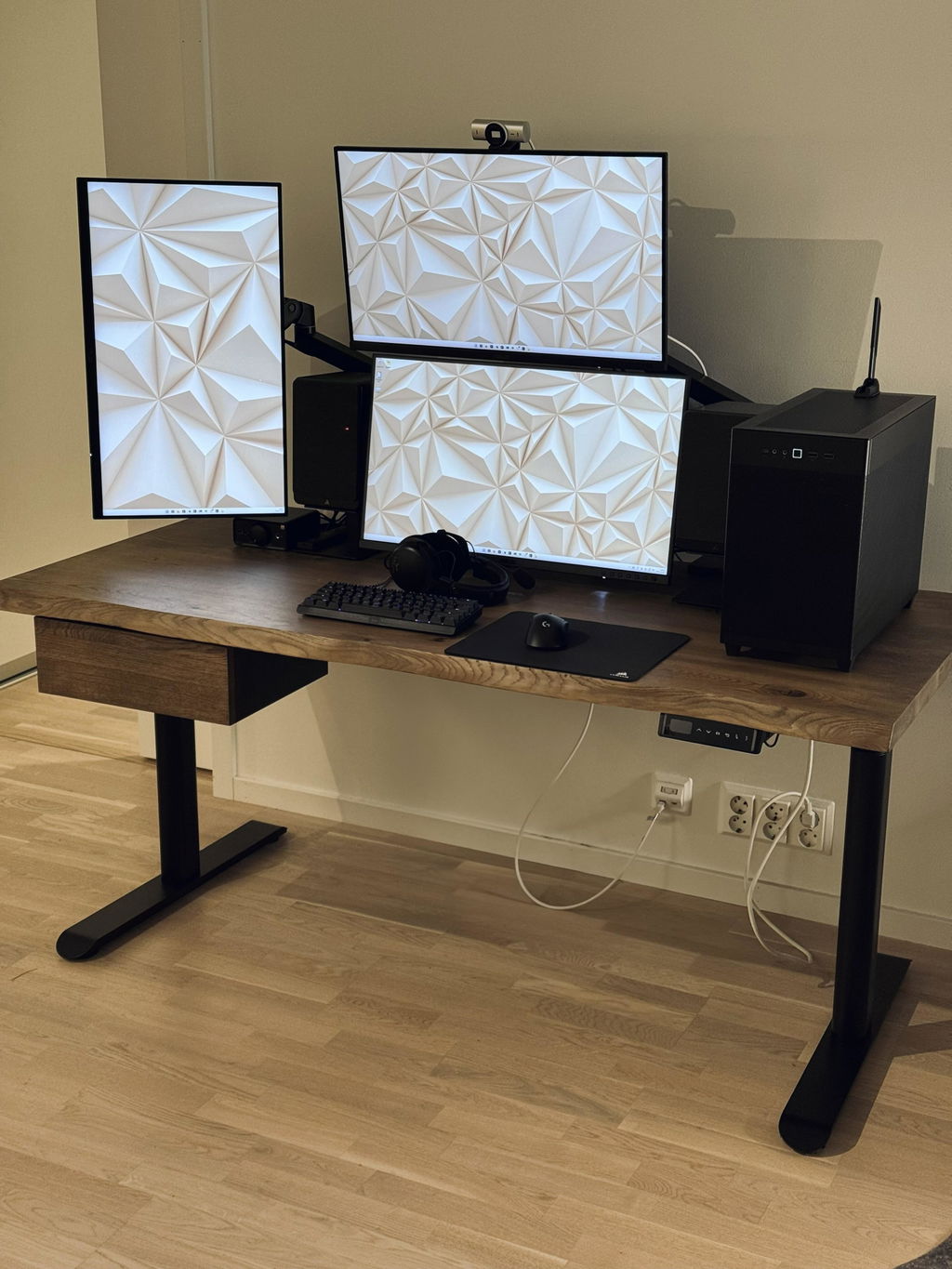
Solid oak has a presence that is difficult to imitate. It has depth at the edge, a warmer touch under your forearms and small variations that make the surface feel individual rather than printed or repeated. A thick solid wood top also gives a standing desk visual balance: the natural weight of the oak complements the clean engineering of a steel frame.
Veneer can offer a refined, more uniform appearance. If you prefer a tightly controlled grain pattern, it may suit a minimalist interior particularly well. It is also generally lighter than a thick solid oak top, which can be useful where a desk must be carried up narrow stairs or moved often.
Neither look is objectively better. The question is whether you want a surface with a consistent finish or one with the natural variation and tactile character of real boards. Oak is never entirely identical from one piece to the next. That is part of its appeal.
Solid wood changes naturally
Wood is a living material, even after it has been made into furniture. It responds subtly to its environment, expanding and contracting as humidity changes. Properly made solid wood tops account for this movement through careful construction and finishing.
Over time, oak can deepen in tone, especially in daylight. Small marks may appear. Rather than making the desk feel worn out, these changes often give it character. For many owners, the surface becomes more personal with use.
Veneer depends on its construction
Engineered cores are typically more dimensionally stable than solid timber. That can be an advantage in rooms with changing temperatures or humidity. Yet the veneer layer itself is thin, and its durability relies on the bond between veneer and core remaining intact.
A well-made veneered desk with a quality plywood core can serve a workspace well for years. A thin veneer over low-density particleboard is a different proposition entirely. This is why asking what is beneath the surface is more useful than simply asking whether a desk is veneered.
Durability Is More Than Scratch Resistance
There is no desktop that is completely immune to use. Keys, metal laptop stands and hurried mornings can all leave their mark. The more relevant question is what happens after that mark appears.
With solid wood, a shallow scratch, water ring or worn patch can often be sanded and refinished. Because the timber continues through the top, the desk has material to work with. It can be repaired, renewed and, in many cases, passed on. This repairability is a central part of long-term value.
Veneer has less margin for error. Minor marks may be improved with careful touch-up, but sanding too deeply can expose the core beneath. Once the veneer is damaged through its thickness, a professional repair may be possible, although it is more complex and less forgiving than refinishing solid timber.
Edges deserve particular attention. A solid oak edge is oak. A veneered edge may be finished with a matching strip, a solid wood lipping or an edging material. The detail can look excellent when executed properly, but it is also an area where low-cost desks often reveal their shortcuts.
Cost, Value and the Long View
Veneer desks usually cost less than solid wood, partly because they use less hardwood and can be produced more efficiently. For a temporary workspace, a first apartment or a tightly defined budget, a well-specified veneer desk may be a sensible choice.
Solid wood requires more material, more careful selection and more labour. It is therefore an investment. The value is not only in the first impression, but in the years that follow: the ability to refresh the surface, the confidence of a substantial top, and the fact that the desk need not be replaced when your space evolves.
A lower initial price is not always lower cost over time. Replacing a desk after a damaged surface, swollen edge or tired-looking finish can quickly close the gap. Conversely, it makes little sense to buy solid wood purely as a status signal if the desk will be exposed to conditions that no natural surface can reasonably withstand. Match the material to the way you work.
The Standing Desk Question
For a height-adjustable desk, the top and frame should be considered as one system. A desk rises and lowers thousands of times over its life. It needs a frame with adequate lifting capacity, stable feet, controlled movement and enough strength for monitors, arms and everyday equipment.
Solid wood is heavier than most veneered tops. That weight is not a disadvantage when the frame is designed for it, but it should never be ignored. Check the complete desk specification rather than assuming any electric frame will perform equally with a thick hardwood top.
The reward is a workspace where oak meets technology without compromise. A solid top brings warmth to an otherwise technical object, while a reliable dual-motor frame makes it practical to change position throughout the day. At OAKO, this combination is central to the idea of a desk that supports both focused work and a considered interior.
What to Check Before You Buy
Material descriptions can be vague, so look beyond phrases such as “oak finish” or “wood effect.” Ask whether the top is solid timber, veneer over plywood, veneer over MDF, or a laminate surface made to resemble wood. These are not interchangeable constructions.
For solid wood, consider the species, thickness, finish and how the boards are joined. For veneer, ask about the core material, veneer thickness, edge construction and whether the surface can be repaired. In both cases, examine the underside, cable access, frame quality and the stated load capacity.
It is also worth thinking about your room. A desk placed beside a radiator, in direct sun or near a frequently opened window needs sensible care regardless of material. Use a desk mat for heavy equipment, wipe spills promptly, and avoid leaving wet cups directly on the surface. Good furniture lasts longer when it is treated as furniture, not as disposable equipment.
Which Desk Is Right for You?
Choose solid wood if you value natural variation, substantial feel and the option to restore the surface over time. It is especially suited to a permanent home office, a studio or a professional workspace where the desk is expected to remain for many years. It also makes sense when the desk is part of the room’s visual identity rather than a background utility.
Choose veneer if budget, lighter weight or a highly uniform appearance matters more than lifetime repairability. A high-quality veneered desk can be a thoughtful purchase, particularly when the construction is transparent and the core is strong.
The best desk is not simply the one that photographs well on delivery day. It is the one that still feels right after the work has changed, the setup has grown and the surface has become unmistakably yours.


Lämna en kommentar
Denna webbplats är skyddad av hCaptcha och hCaptchas integritetspolicy . Användarvillkor gäller.